Originally published by Matt Palmer in December 2021, updated August 2026 by Zuar's Joel Stellner to reflect the evolution of modern database architectures and AI-readiness requirements.
Overview
Databases are the invisible infrastructure behind nearly everything — online banking, airline reservations, medical records, e-commerce, and the AI models reshaping every industry. But the database landscape in 2026 looks dramatically different from even a few years ago.
The rise of AI workloads, real-time analytics, and the explosion of unstructured data have fundamentally shifted what organizations need from their database layer. Choosing a database used to be a question of "relational or non-relational?" Today, the question is broader: Does your database support the full journey from raw data to AI-powered decision-making — and can your platform turn that data into action?
This guide breaks down every major database category in 2026, explains how AI is reshaping database requirements, and helps you select the right foundation for a modern data stack.
What Is a Database?
A database is a shared collection of related data used to support the activities of a particular organization. It can be viewed as a repository of data that is defined and accessed by various users (Database Design 2nd Ed, Watt & Eng).
In practice, databases differ by intended purpose — each is dependent on the type of data stored and the type of transactions that occur. Is data most frequently being read or written? Does it need to be accessed by row or column? How does the database management system ensure control over data integrity, avoid redundancy, and secure data while performing optimally?
These questions still matter. But in 2026, a new set of questions sits on top of them: Can this database serve AI models efficiently? Can it handle vector embeddings alongside structured records? Does it integrate into automated pipelines that feed analytics, dashboards, and AI assistants without manual intervention?
How AI Is Changing Database Requirements
Before diving into database types, it's worth understanding why the landscape has shifted so significantly. Three forces are driving the change:
1. The Vector Data Explosion
Large language models (LLMs), recommendation engines, image recognition systems, and semantic search all rely on vector embeddings — high-dimensional numerical representations of text, images, audio, and other unstructured data. Traditional relational databases weren't designed to store or query these efficiently. This has given rise to an entirely new database category — vector databases — and pushed established players like PostgreSQL (via pgvector) and Snowflake to add native vector support.
2. Real-Time and Streaming Demands
AI-powered applications don't wait for nightly batch jobs. Fraud detection, dynamic pricing, personalized recommendations, and operational AI agents all require data that's current to the second, not the hour. This has accelerated adoption of streaming-first architectures and databases optimized for real-time ingestion and querying.
3. The "Last Mile" Problem
Here's the shift that most database guides miss: selecting the right database is necessary but not sufficient. The real challenge in 2026 isn't getting data into a database — it's getting data out of it and into the hands of every decision-maker in a way that's contextual, actionable, and secure.
This is what Zuar calls the "last mile" — the gap between clean, well-modeled data and the humans (or AI systems) that need to act on it. A Data Experience Platform (DXP) like Zuar sits on top of your database and BI layer to close that gap, handling embedded analytics, AI-assisted content creation, data writeback, workflow automation, and branded portals — all in a single governed framework. Your database is the foundation. The DXP is what makes the foundation useful.
 Joel Stellner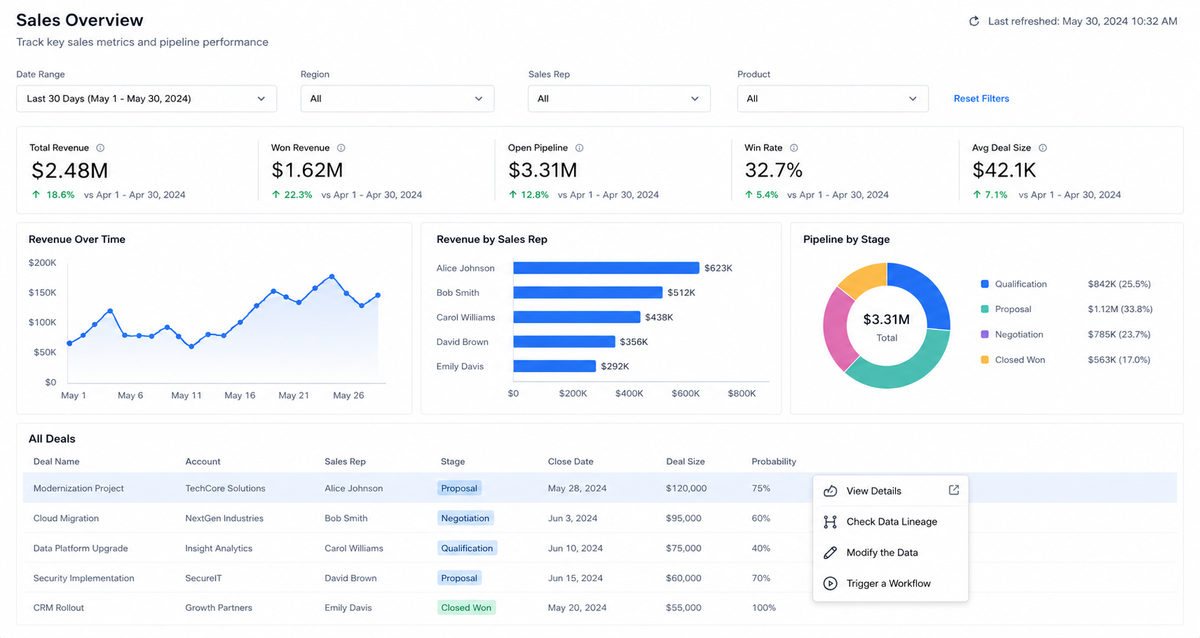
Database Structures: The Foundation
Understanding database structures is the starting point for selecting the right technology. Here are the core architectural models:
Hierarchical databases organize data in a parent-child, tree-like structure where each schema has a single root. These are largely legacy systems today, though their influence persists in directory services like LDAP.
Network databases extend the hierarchical model by allowing a child record to link to several parent records, enabling multi-directional relationships. While rarely deployed as standalone systems in 2026, the concept lives on in modern graph databases.
Object-oriented databases (OODBs) store data as objects — the same structures used in object-oriented programming languages. They reduce the overhead of flattening complex objects for storage and are used in specialized applications like CAD/CAM systems and scientific computing.
Relational databases structure data as two-dimensional arrays — tables organized by rows and columns. They use keys within columns to create relationships between tables. Relational databases remain the backbone of most enterprise data infrastructure, and SQL remains the lingua franca of data.
Non-relational databases (often called NoSQL) don't use the tabular schema of relational systems. Instead, they use a variety of data models — documents, key-value pairs, graphs, wide columns — enabling greater flexibility and horizontal scalability for specific workloads.
Most organizations still rely on a relational database leveraging SQL (RDBMS) as their primary system of record, but the modern data stack increasingly includes non-relational databases for specialized workloads — and in 2026, vector databases for AI.
Relational Database Systems (RDBMS)
A relational database stores data in tables and rows (also called records). The term dates back to the 1970s, coined by researchers at IBM, and the model has proven remarkably durable. Popular relational systems include PostgreSQL, MySQL, Microsoft SQL Server, and cloud-native platforms like Amazon Aurora and Google Cloud SQL.
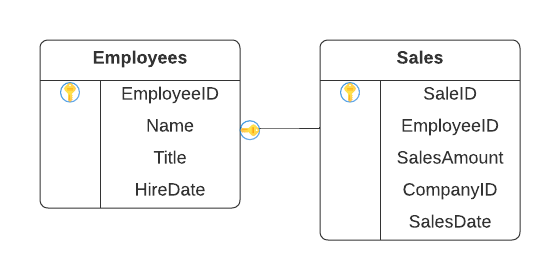
Relational databases work by linking information across tables through keys. A primary key uniquely identifies a row in one table. When that identifier appears in another table, it becomes a foreign key, and the two records can be "joined" using SQL. This primary key / foreign key relationship is the mechanism that gives relational databases their defining advantage: referential integrity — the consistency and accuracy of data across related tables.
Why RDBMS Still Dominates in 2026
Despite the proliferation of specialized databases, relational systems remain the default for transactional workloads, financial systems, ERP, CRM, and any application where data consistency and ACID compliance are non-negotiable. The ecosystem of tooling, talent, and integration around SQL is unmatched.
What's changed is that modern RDBMS platforms have expanded well beyond their traditional boundaries. PostgreSQL now supports JSON documents, full-text search, geospatial queries, and — critically for AI workloads — vector similarity search via the pgvector extension. The line between "relational" and "non-relational" has blurred considerably.
Non-Relational Databases (NoSQL)
Non-relational databases store data without the rigid table-and-row structure of RDBMS. Instead, they use models optimized for specific data types and access patterns. The four primary categories are document stores, key-value stores, wide column stores, and graph databases.
NoSQL databases rose to prominence in the 2010s as web-scale applications demanded horizontal scalability and schema flexibility that traditional RDBMS couldn't easily provide. In 2026, they remain essential for specific workloads — but the "SQL vs. NoSQL" debate has largely given way to a more pragmatic "use the right tool for the job" approach.
 Team Zuar
Popular Modern Databases in 2026
Snowflake
Snowflake is a cloud-native analytic data platform provided as Software-as-a-Service (SaaS). Originally known as a data warehouse, Snowflake has evolved into a broader data cloud that supports data engineering, data science, data sharing, data applications, and — increasingly — AI/ML workloads.
Snowflake's architecture separates compute from storage, allowing organizations to scale each independently. In 2026, Snowflake has added Cortex AI for running LLMs and ML models directly against warehouse data, plus native support for unstructured data processing. It remains a dominant choice for organizations that need a scalable, multi-cloud analytical foundation.
For organizations using Snowflake as their analytical backbone, tools like Zuar Runner automate the data pipeline — pulling from 100+ sources (CRMs, ERPs, APIs, files, legacy databases) and delivering analytics-ready data into Snowflake on a schedule, without manual intervention.
Databricks
Databricks has emerged as a major force in the database landscape by pioneering the lakehouse architecture — a hybrid that combines the low-cost storage of data lakes with the performance and governance of data warehouses. Built on Apache Spark, Databricks excels at large-scale data engineering, machine learning, and AI workloads.
In 2026, Databricks' Unity Catalog provides unified governance across structured and unstructured data, and its tight integration with MLflow makes it a natural choice for organizations where data science and AI model training are primary use cases. Databricks is particularly strong for teams that need to run heavy compute workloads (model training, feature engineering, large-scale transformations) alongside traditional analytics.
Amazon Redshift
Amazon Redshift is a fully managed, petabyte-scale data warehouse service in the AWS cloud. It remains a cost-effective solution for running high-performance analytical queries, generating real-time operational analytics, sharing data securely, and building predictive analytics.
Redshift has kept pace with the AI era through Redshift ML (which lets users create, train, and deploy ML models using SQL), integration with Amazon Bedrock for generative AI, and Redshift Serverless for elastic, pay-per-query workloads. For AWS-native organizations, Redshift's deep integration with the broader AWS ecosystem — S3, SageMaker, Lambda, Glue — makes it a natural analytical hub.
PostgreSQL
PostgreSQL (Postgres) is a free, open-source object-relational database management system (ORDBMS) that has become arguably the most important database in the modern stack. Its reputation for reliability, extensibility, and standards compliance has made it the default choice for a remarkable range of use cases.
What makes PostgreSQL uniquely relevant in 2026 is its extensibility. The pgvector extension enables vector similarity search, making Postgres a viable option for AI applications that need vector storage alongside traditional relational data — without deploying a separate vector database. Extensions like PostGIS (geospatial), TimescaleDB (time-series), and pg_cron (scheduling) mean a single PostgreSQL instance can serve workloads that would otherwise require multiple specialized databases.
PostgreSQL is also the engine behind many cloud-managed offerings (Amazon RDS, Google Cloud SQL, Azure Database for PostgreSQL, Supabase, Neon), making it accessible at virtually any scale.
MySQL
MySQL remains one of the most widely deployed databases globally. As a free, open-source RDBMS, it runs on virtually all platforms and powers a significant portion of the web — from WordPress sites to large-scale SaaS applications.
MySQL offers industry-leading data security, on-demand flexibility from small footprints to massive warehouses, high-performance storage engines, 24/7 uptime with high availability solutions, and comprehensive transaction support. In 2026, MySQL HeatWave adds in-database machine learning and analytics capabilities, and MySQL's integration with Oracle Cloud Infrastructure has expanded its enterprise footprint.
Microsoft SQL Server
Microsoft SQL Server is an RDBMS that supports a wide variety of analytic applications, transaction processing, and business intelligence. Organizations can deploy it on-premise, in Azure (as Azure SQL), or on Linux and Docker systems.
As part of the Microsoft ecosystem, SQL Server integrates tightly with Power BI, Azure Synapse Analytics, and Azure Machine Learning. For organizations already invested in Microsoft's stack, SQL Server provides a natural path from transactional data to analytics to AI — though that path often benefits from a Data Experience Platform layer to unify the delivery of insights across tools and audiences.
Google BigQuery
Google BigQuery is a serverless, highly scalable enterprise data warehouse designed for large-scale analytics. Its serverless architecture means there's no infrastructure to manage — you simply query data and pay for what you use.
BigQuery has become particularly relevant for AI workloads through BigQuery ML (which lets analysts build and deploy ML models using SQL), integration with Vertex AI for advanced model training, and native support for unstructured data via BigQuery's object tables. For organizations running on Google Cloud, BigQuery's integration with Looker, Dataflow, and Pub/Sub creates a cohesive analytical pipeline.
Specialized Database Categories
Vector Databases
Vector databases are the breakout database category of the AI era. Purpose-built to store, index, and query high-dimensional vector embeddings, they power the retrieval layer behind semantic search, retrieval-augmented generation (RAG), recommendation engines, image similarity, and anomaly detection.
Leading vector databases include Pinecone, Weaviate, Milvus, Qdrant, and Chroma. Each offers optimized indexing algorithms (HNSW, IVF, product quantization) that enable approximate nearest neighbor (ANN) searches across millions or billions of vectors in milliseconds.
The vector database landscape is evolving rapidly. Dedicated vector databases offer the best performance for pure vector workloads, but integrated solutions — PostgreSQL with pgvector, Snowflake's vector support, Elasticsearch's dense vector fields — are compelling for organizations that want to avoid managing yet another specialized system.
Best suited for:
- RAG pipelines for LLM applications
- Semantic and similarity search
- Recommendation engines
- Image, audio, and video retrieval
- Anomaly detection in high-dimensional data
Key-Value Stores
Key-value stores like Redis, Amazon DynamoDB, and Memcached provide fundamental services for retrieving the value associated with a known key. Their simplicity makes them exceptionally fast and horizontally scalable.
In 2026, key-value stores have found new relevance as caching layers for AI applications, session stores for real-time personalization, and feature stores for ML model serving. Redis in particular has expanded well beyond simple caching — Redis Stack includes vector search, JSON document support, time-series data, and graph capabilities.
Best suited for:
- Caching and session management
- Real-time leaderboards and counters
- Feature stores for ML model serving
- High-throughput, low-latency lookups
Wide Column Stores
Wide column stores like Apache Cassandra, Google Bigtable, and ScyllaDB are schema-agnostic systems designed to scale to petabytes across distributed clusters. They store data in column families, with each row containing a multi-dimensional key-value structure.
These databases excel at write-heavy workloads with predictable access patterns — IoT telemetry, event logging, time-series data at massive scale, and messaging systems. In the AI context, wide column stores serve as efficient storage for training data pipelines and feature engineering at scale.
Best suited for:
- IoT and sensor data at massive scale
- Event logging and audit trails
- Time-series data (at very high volume)
- Write-heavy distributed workloads
Document Stores
Document stores like MongoDB, Couchbase, and Amazon DocumentDB store data as JSON (or BSON) documents. Each document is schema-free, can contain nested structures, and is identified by a unique key.
MongoDB remains the dominant document database, and in 2026 it has added Atlas Vector Search (enabling vector similarity queries alongside document queries), Atlas Stream Processing for real-time data pipelines, and enhanced integration with AI/ML frameworks. This makes MongoDB a viable "do-everything" database for applications that need flexible schemas, vector search, and real-time capabilities in a single system.
Best suited for:
- Content management and catalog systems
- Mobile and web application backends
- Semi-structured and polymorphic data
- Applications requiring rapid schema evolution
Graph Databases
Graph databases like Neo4j, Amazon Neptune, and TigerGraph represent data as networks of nodes (entities) and edges (relationships). They excel at queries that traverse relationships — finding paths, detecting patterns, and analyzing connectivity.
Graph databases have gained significant traction in the AI era for several reasons: knowledge graphs power RAG systems and AI reasoning, graph neural networks (GNNs) are advancing in areas like drug discovery and fraud detection, and the relationship-centric data model maps naturally to the way LLMs need to understand entity connections.
Best suited for:
- Knowledge graphs for AI and RAG
- Fraud detection and network analysis
- Social networks and recommendation engines
- Supply chain and dependency mapping
- Identity and access management
Time-Series Databases
Time-series databases like InfluxDB, TimescaleDB, and Amazon Timestream are optimized for data that is indexed and queried by time — metrics, events, measurements, and observations that arrive in chronological order.
The explosion of IoT devices, observability platforms, and real-time AI monitoring has made time-series databases essential infrastructure. They offer specialized compression, retention policies, continuous aggregation, and downsampling that general-purpose databases can't match at scale.
Best suited for:
- Infrastructure and application monitoring
- IoT sensor data and telemetry
- Financial market data and tick-by-tick analysis
- AI model performance monitoring and drift detection
- Energy, manufacturing, and industrial analytics
Search Engine Databases
Search engine databases like Elasticsearch, Apache Solr, and OpenSearch store data using schema-free JSON documents with a high emphasis on text-based search and analytics over semi-structured or unstructured data.
In 2026, Elasticsearch has evolved significantly — adding dense vector search for AI-powered semantic queries, the Elasticsearch Relevance Engine (ESRE) for hybrid search (combining traditional keyword matching with vector similarity), and native integration with LLM frameworks. This positions search engines as a convergence point between traditional full-text search and AI-powered retrieval.
Best suited for:
- Full-text search and log analytics
- Hybrid search (keyword + semantic)
- Observability and security analytics
- E-commerce product search
- Content discovery and recommendation
NewSQL Databases
NewSQL databases like CockroachDB, Google Spanner, TiDB, and YugabyteDB represent a category that emerged to solve a specific tension: the need for the horizontal scalability of NoSQL with the ACID guarantees and SQL interface of traditional relational databases.
These databases are particularly relevant for globally distributed applications that need strong consistency across regions — financial services, multi-region SaaS platforms, and any application where "eventually consistent" isn't acceptable. In the AI era, NewSQL databases provide the transactional backbone for AI-powered applications that need to read and write structured data at global scale with guaranteed consistency.
Best suited for:
- Globally distributed transactional applications
- Multi-region SaaS platforms
- Financial systems requiring strong consistency at scale
- Applications migrating from single-node RDBMS to distributed architectures
How to Choose: A Decision Framework for 2026
Selecting the right database has always required matching your workload to the right architecture. In 2026, the evaluation criteria have expanded. Here's a practical framework:
Start With Your Workload Profile
Transactional (OLTP): If your primary workload is reading and writing individual records with strong consistency — orders, user accounts, financial transactions — start with a relational database (PostgreSQL, MySQL, SQL Server). If you need global distribution, consider NewSQL (CockroachDB, Spanner).
Analytical (OLAP): If you're running complex queries across large datasets for reporting and analytics, a cloud data warehouse (Snowflake, BigQuery, Redshift, Databricks) is the right foundation.
AI and ML: If your workload involves vector embeddings, similarity search, or RAG pipelines, you need vector capabilities — either a dedicated vector database (Pinecone, Weaviate) or vector extensions on an existing platform (pgvector, Atlas Vector Search).
Real-time: If you need sub-second query responses on continuously arriving data, consider time-series databases (InfluxDB, TimescaleDB), streaming platforms (Apache Kafka + ksqlDB), or real-time-optimized warehouses (Snowflake Dynamic Tables, BigQuery streaming).
Unstructured/Semi-structured: If your data is primarily documents, JSON, or content with variable schemas, document stores (MongoDB, Couchbase) or search engines (Elasticsearch) are natural fits.
Then Ask the AI-Readiness Questions
Beyond the traditional workload fit, evaluate every database candidate against these 2026-specific criteria:
- Vector support: Can this database store and query vector embeddings natively or via extension? If your AI roadmap includes semantic search, RAG, or recommendation systems, this is no longer optional.
- Unstructured data handling: Can it process or reference unstructured data (text, images, PDFs) alongside structured records? AI applications increasingly need both.
- Real-time capability: Can it serve fresh data to AI models and analytics without batch delays? AI-powered applications that act on stale data deliver stale results.
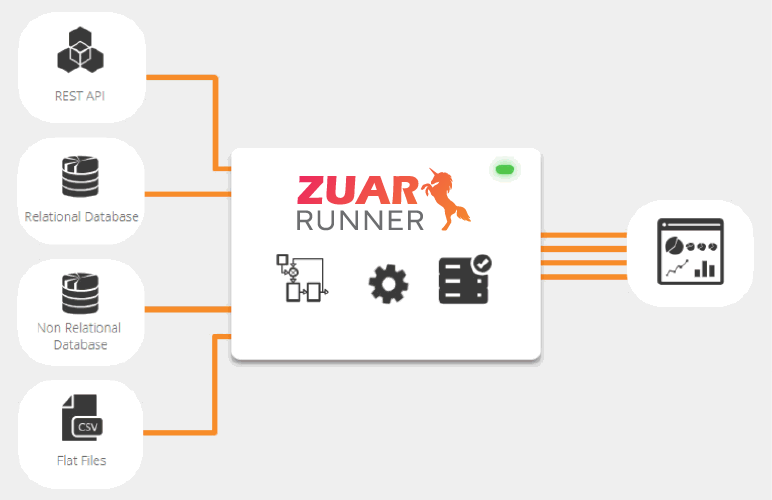
- Pipeline integration: Does it integrate cleanly with automated data pipelines? Manual data movement is the enemy of AI-readiness. Tools like Zuar Runner automate data acquisition from 100+ sources — CRMs, ERPs, APIs, files, cloud apps, legacy databases — and deliver analytics-ready data on a schedule.
- Governance and security: Does it support row-level security, role-based access, and audit logging? AI systems that access sensitive data need the same governance controls as human users — arguably more.

Finally, Think Beyond the Database
Here's the insight that separates good database decisions from great data strategies: the database is the foundation, not the destination.
The most common failure pattern in 2026 isn't choosing the wrong database — it's choosing the right database and then failing to close the "last mile" between stored data and human (or AI) action. Organizations invest heavily in data warehouses and pipelines, then deliver insights through fragmented dashboards, PDF exports, and disconnected tools.
This is where a Data Experience Platform changes the equation. A DXP like Zuar sits on top of your database and BI investments to provide:
- Embedded analytics — Deliver insights inside branded portals for internal teams, customers, and partners, with tools like Tableau, Power BI, and ThoughtSpot embedded in a single governed destination.
- AI analytics assistants — Conversational analytics with governance, user-aware access, and row-level security, so every stakeholder can query data in natural language.
- Data writeback and workflow automation — Move from read-only reporting to action. Update CRM records, trigger alerts, approve budget lines, and kick off workflows directly from the analytics layer.
- No-code to full-code flexibility — Build with drag-and-drop, low-code, AI-assisted vibecoding, or full custom code — all within the same governed framework, using open standards like SQL, Python, JavaScript, HTML, and CSS.
- Future-proof architecture — Built on open standards rather than proprietary models, so your analytics layer isn't locked to a single vendor's ecosystem. As the BI category splits into traditional BI and Data Experience Platforms, organizations that invest in the DXP layer gain portability and long-term flexibility.
The database stores your data. The pipeline automates its movement. The DXP turns it into decisions and actions. All three layers matter — but the last mile is where most organizations lose the value they've already built.


Frequently Asked Questions
What is the best database for AI applications in 2026?
There's no single "best" database for AI — it depends on the workload. For vector search and RAG pipelines, dedicated vector databases (Pinecone, Weaviate) or PostgreSQL with pgvector offer strong options. For large-scale model training and feature engineering, Databricks and Snowflake excel. For transactional AI applications, PostgreSQL or a NewSQL database like CockroachDB provides the consistency guarantees AI-powered workflows require. The key is ensuring your database integrates into an automated pipeline and a delivery layer that gets AI-powered insights to the people who need them.
What is a vector database, and do I need one?
A vector database stores and queries high-dimensional vector embeddings — numerical representations of text, images, audio, or other unstructured data. If your AI roadmap includes semantic search, retrieval-augmented generation (RAG), recommendation engines, or similarity matching, you need vector capabilities. Whether that means a dedicated vector database or a vector extension on your existing database (like pgvector for PostgreSQL) depends on scale and performance requirements.
How do I choose between a data warehouse and a data lakehouse?
Data warehouses (Snowflake, Redshift, BigQuery) are optimized for structured, analytics-ready data with strong governance and SQL-first querying. Lakehouses (Databricks, Delta Lake) combine the low-cost storage of data lakes with warehouse-like performance and governance, and they're particularly strong for organizations with heavy data science and ML workloads. If your primary use case is business analytics and reporting, a warehouse is typically the simpler path. If you're doing significant model training, feature engineering, or working with large volumes of unstructured data, a lakehouse architecture may be the better fit.
What is the "last mile" problem in data, and how do I solve it?
The "last mile" is the gap between having clean, well-modeled data in a database or warehouse and actually getting that data into the hands of every decision-maker — internal teams, executives, customers, partners — in a way that's contextual, actionable, and secure. Most organizations solve the pipeline and storage layers well but underinvest in the delivery layer. A Data Experience Platform (DXP) like Zuar closes this gap by unifying embedded analytics, AI assistants, data writeback, workflow automation, and branded portals on top of your existing data infrastructure.
Can I use multiple database types together?
Absolutely — and most modern data architectures do. A common pattern in 2026 is a relational database (PostgreSQL) for transactional data, a cloud data warehouse (Snowflake, BigQuery) for analytics, and a vector database or extension for AI workloads. The key is connecting them through automated pipelines rather than manual data movement. Zuar Runner automates data acquisition from 100+ sources and delivers analytics-ready data into your warehouse, eliminating the manual work of keeping multiple systems in sync.
How has PostgreSQL become relevant for AI workloads?
PostgreSQL's extensibility is the key. The pgvector extension adds native vector similarity search, enabling PostgreSQL to store and query vector embeddings alongside traditional relational data. This means organizations can add AI capabilities — semantic search, RAG, recommendation — to their existing PostgreSQL infrastructure without deploying a separate vector database. Combined with extensions like PostGIS (geospatial), TimescaleDB (time-series), and its native JSON support, PostgreSQL has become a remarkably versatile foundation for modern data architectures.
Your database is the foundation. Your pipeline automates the flow. But the real competitive advantage comes from what sits on top — the experience layer that turns data into decisions. Learn how Zuar's Data Experience Platform unifies your data infrastructure into a branded, AI-ready analytics headquarters for every stakeholder.
