Key Takeaways
- The recent generation of BI leaders were built to answer "what happened?" Equipment rental businesses need a platform that answers "what should we do about it, and can the platform help us do it?"
- Zuar DXP is built for the ETL reality of equipment rental: ERP systems, telematics, maintenance tools, homegrown databases, and every other data source your operation depends on—connected, modeled, and made analytics-ready.
- Zuar DXP goes far beyond drag-and-drop BI: AI-assisted dashboard construction, writeback, triggered workflows, and live data interactions turn reports into operational tools.
- One platform serves internal operators, external customer portals, and partner/vendor dashboards—with block-level content security, granular governance, and complete branding control per audience.
- Existing BI tools and legacy reports can be embedded into Zuar DXP immediately, ensuring a smooth transition on your timeline—not a forced rip-and-replace.
- Zuar has a dedicated Equipment Rental Content Pack and extensive industry experience. Through Zuar Labs, businesses achieve rapid deployment, high adoption, and continuous improvement from day one.
The Real BI Problem in Equipment Rental Isn't just the Dashboard. It's Everything Before It.
Equipment rental is a data-intensive business. Fleet utilization, LTA vs. STR balances, recovery charges, overdue and unaccounted units, contract profitability by customer and equipment class, branch performance, maintenance cycles, telematics feeds—the operational picture is built from dozens of data streams, and those streams rarely live in the same system.
Most rental operators have a rental ERP at the core, but the data reality looks more like this: contracts in one system, invoice and billing data in another, service records in a third, branch-level spreadsheets filling the gaps, and telematics or maintenance platforms adding another layer entirely. Without a proper integration and analytics foundation, teams spend their days reconciling numbers instead of acting on them.
This is why the BI decision for an equipment rental business is fundamentally different from a generic "Power BI vs. Tableau" comparison. The visualization layer is almost the last consideration. What matters first is whether your BI platform can reach your data—and whether it can turn that data into action.
The global BI market reached $41.16 billion in 2026, yet Gartner research shows that 70–80% of BI projects fail to deliver expected business value. In equipment rental, those failures follow a predictable pattern: the demo looks great on clean sample data, but connecting to a real rental ERP or legacy homegrown system turns a Q1 rollout into a Q3 rescue project. The problem isn't budget. It's architecture.
 Whitney Myers
What Equipment Rental BI Actually Requires
Before evaluating any platform, equipment rental leaders should map what their BI stack actually needs to do:
Fleet and Utilization Visibility — Track LTA/STR ratios, idle asset status, and utilization rates in real time. Identify which equipment classes are overutilized, underperforming, or awaiting recovery. Surface the data that drives capital planning and replacement decisions.
Branch and Regional Performance — Location-specific reporting that compares inventory movement, transfer activity, and local profitability across yards, regions, and service areas—with filters by branch, equipment class, and contract type.
Contract and Customer Profitability — True margin analysis that combines rental revenue with delivery, service, maintenance, and financing costs. Finance and sales need account-level and contract-level margin visibility, not just top-line revenue.
Operational Dashboards for Every Team — Dispatch needs availability and reservation status. Service needs work order and downtime views. Finance needs aging, utilization trends, and recovery charges. Sales needs quote pipeline and account performance. All from the same trusted data pipeline.
Customer and Partner-Facing Analytics — As rental businesses grow, customers increasingly expect self-service access to their own rental history, equipment status, charges, and credits. Vendors and partners need their own view. Delivering that securely, branded, and at scale requires more than a BI tool with an embed license.
Writeback and Workflow Integration — Flags for overdue maintenance, low utilization alerts, contract renewal triggers, and recovery workflows should do more than populate a report. They should trigger action.
This is the operational picture. And it's exactly the picture the last generation of BI platforms was not designed to support.
Why the Last Generation of BI Leaders Falls Short
The platforms that have dominated the Gartner Magic Quadrant for the past decade—Power BI, Tableau, Looker—represent a specific category of software built around a specific premise: take clean, structured data and make it easy to visualize.
That premise was fine when the data was already clean and structured, the audience was internal analysts, and the deliverable was a static dashboard reviewed once a week. In 2026, that describes almost no equipment rental business at scale.
Here's what the traditional BI stack cannot do:
- It cannot reliably connect to and combine data from legacy rental ERPs, homegrown databases, or proprietary telematics systems without significant custom ETL work.
- It treats data as read-only. Finance can annotate a forecast in Excel, but they cannot push that annotation back through a Power BI dashboard.
- It cannot serve an equipment customer their own rental summary, charge history, or unaccounted unit report in a branded portal without expanded/OEM licensing + months of engineering a framework to embed into.
- It cannot trigger a workflow when a metric crosses a threshold. A dashboard showing 23 overdue/unaccounted units is informative. A platform that routes that alert to the right operations team—automatically—is operational.
- It cannot consolidate multiple BI tools and legacy reports in a single, governed, branded destination.
These aren't edge cases or advanced features. They're the core requirements of a rental operation trying to run efficiently at scale.
The BI category is splitting in two. On one side: platforms optimized for standardized charts and analyst-facing exploration. On the other: Data Experience Platforms—unified layers that handle the full journey from messy source data to governed, branded, action-oriented analytics for every audience. Zuar DXP is built for the second category.
 Joel Stellner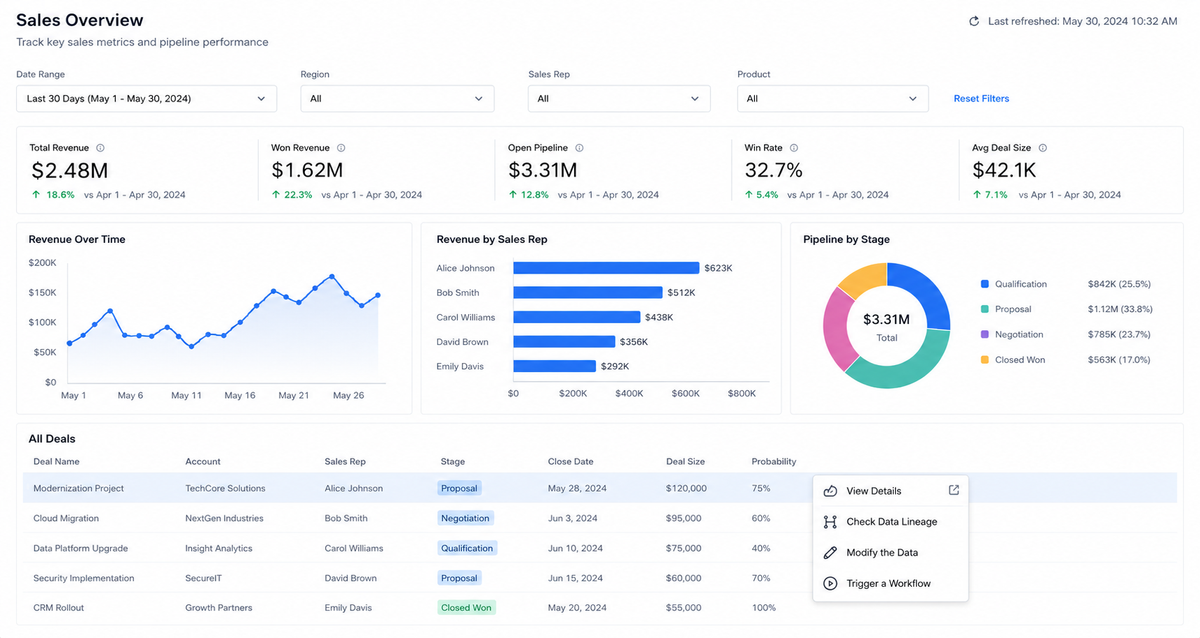
Introducing Zuar DXP: The BI Foundation Equipment Rental Businesses Have Been Waiting For
"Zuar is not just a BI vendor or a portal tool. Zuar is a full-stack Data Experience Platform (DXP) that unifies data pipelines, analytics delivery, embedded BI, AI analytics assistants, automation, writeback, and workflow integration in one governed framework."
Zuar DXP was designed from first principles to serve organizations where data is complex, audiences are multiple, and analytics must drive action—not just inform it. For equipment rental businesses, this is not a generic fit. It is a purpose-built match.
The platform has three core layers that work together as a unified whole:
- Zuar Runner — Data acquisition, ETL, modeling, orchestration, and custom backend jobs that make any data source analytics-ready.
- Zuar Portal — Branded frontend, embedded analytics hub, no-code to full-code application layer, and the governed interface for every audience.
- Zuar Labs — The services and customer success division that delivers outcomes, not just licenses.
1. Runner: Getting Data Out of Any ERP, Legacy System, or Operational Tool
Equipment rental data doesn't live in one place. It never has. The ERP, accounting system, maintenance platform, dispatch tool, telematics feed, and branch spreadsheets each hold a piece of the picture—and most of them weren't designed to be analytics-friendly.
Zuar Runner (the backend automation engine of the Zuar DXP) is built specifically for this integration reality.
Runner is a full pipeline orchestration engine—not just a connector layer. It handles data acquisition from APIs, relational databases, flat files, cloud storage, custom endpoints, legacy ERPs, and homegrown systems that have no native integration support. When a rental business runs an ERP that vendors no longer support, or a custom dispatch system built a decade ago, Runner still gets to the data.
Once the data is acquired, Runner doesn't just move it. It models it:
- Schema detection and normalization across sources with different structures, date formats, and naming conventions.
- Semantic mapping so that "Equipment Class" means the same thing whether it comes from the ERP, the maintenance system, or the telematics feed.
- Materialized analytical tables that are refreshed on schedule, delivering high-performance dashboard queries without hammering operational systems.
- Custom job types — SQL, Python, and BASH — for any transformation logic the business requires.
- Orchestration and sequencing — jobs run in the right order, on the right schedule, with monitoring and conditional triggers.
For equipment rental businesses with complex, layered data environments, Runner is not a nice-to-have. It is the foundation that makes everything else possible. It's the reason Zuar customers go from "our data is a mess" to "our dashboards are trusted" in weeks, not quarters.
 Joel Stellner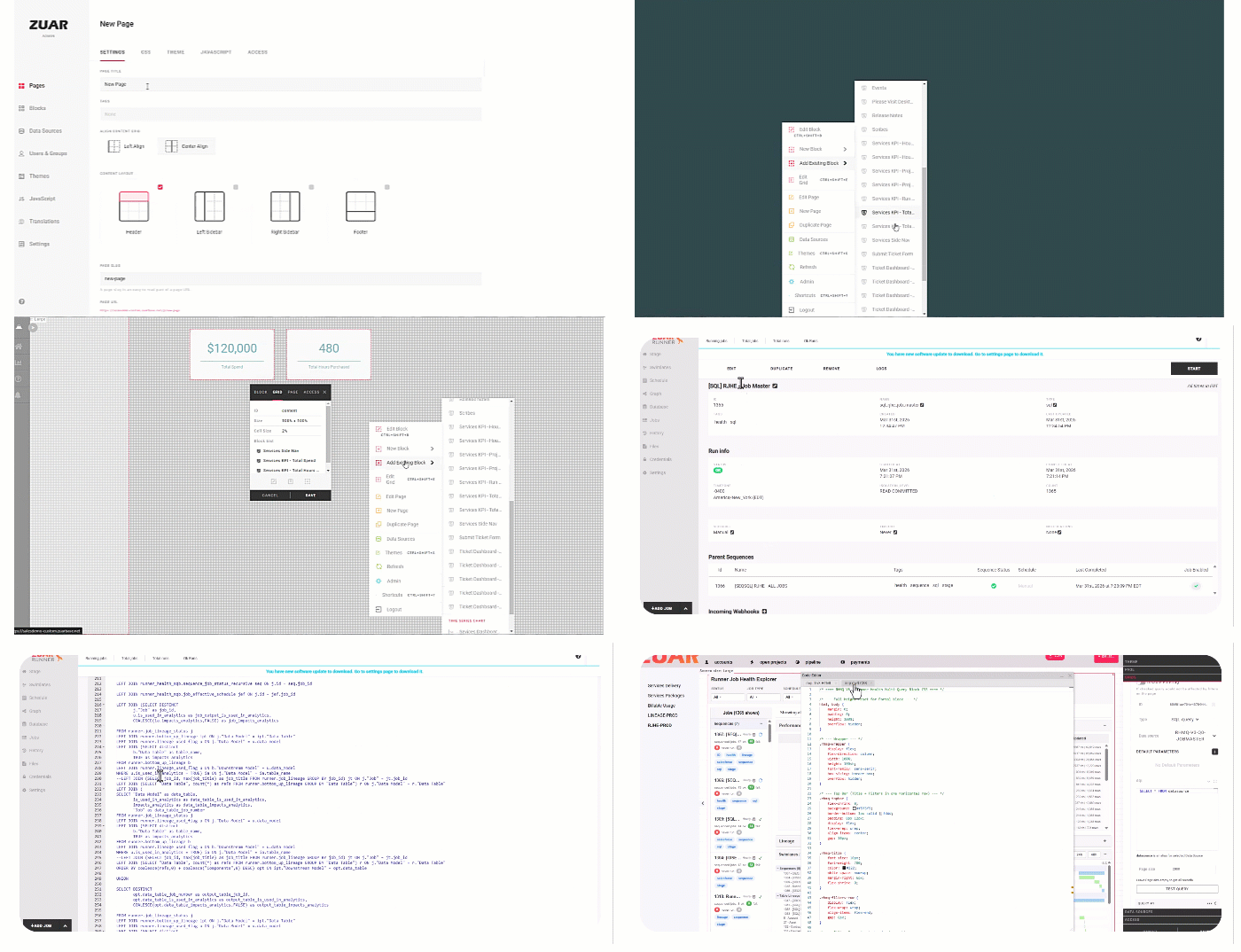
2. Beyond Drag-and-Drop: AI-Powered Dashboards That Drive Action
The dashboard the previous generation of BI leaders gave you was the end of the workflow. You saw a number. You clicked through. You exported to Excel. You moved on.
Zuar DXP positions the dashboard as the beginning of the workflow.
AI-Assisted Dashboard Construction
Zuar Portal 1.19 introduces the Experience Assistant—an AI-powered application builder that generates visualizations from natural language descriptions. Data-savvy analysts can describe what they need and have the AI generate the HTML, CSS, JavaScript, and D3.js visualization within Portal's governed Block framework—all without requiring a dedicated front-end engineering team.
This is what a modern dashboard development workflow looks like: describe it, generate it, govern it, deploy it. The gap between "we have an idea for a fleet utilization view" and "it's live in production" collapses from weeks to hours.
A Development Spectrum for Every Team
Zuar DXP supports no-code drag-and-drop for common elements, low-code template blocks for standard components, AI-assisted vibecoding for advanced custom visualizations, and full-code for teams that want direct HTML, CSS, JavaScript, Python, or SQL control. All of it runs inside the same governed framework—the same Row-Level Security, SSO, and credential controls, regardless of how the content was built.
Dashboards That Trigger Action
This is the structural difference that matters most for operations:
- Writeback — Users can push data from the analytics layer back into operational systems. Annotate a contract status, approve a maintenance flag, update a classification—without leaving the dashboard.
- Triggered Jobs and Sequences — Runner jobs can be triggered from Portal events. A fleet utilization threshold crossed triggers an alert workflow. An unaccounted unit count over threshold routes a task to the recovery team.
- Data Curation and Classification — Dashboards aren't passive. They can classify and curate data as part of the user interaction.
For an equipment rental operation, this means a dashboard showing 23 overdue/unaccounted units doesn't just inform—it can initiate the recovery workflow directly. A customer whose utilization exceeds contract terms triggers a notification sequence automatically. The analytics environment becomes the operational hub.
3. One Platform for Every Audience—With Granular Security and Complete Branding Control
Equipment rental businesses serve multiple distinct audiences, and each of them needs a different view of the same underlying data:
- Internal operators and branch managers need fleet availability, maintenance schedules, and location performance.
- Finance and executives need consolidated margin reporting, aging, and utilization trends.
- External customers need their own equipment status, rental balance, charge history, and unaccounted unit counts.
- Vendors and partners need their own scoped view of relevant operational data.
Most BI platforms require separate tools, separate licensing structures, or significant engineering to serve more than one of these audiences securely from the same infrastructure. Zuar DXP was designed from the start to serve all of them from one governed platform.
Integrated Security and Governance
Security in Zuar DXP is enforced at multiple layers:
- Data source level — Row-Level Security is enforced at the connection level and cannot be bypassed by application code. A customer can only see their own records. A branch manager can only see their location. These rules are not applied at the dashboard layer where they can be circumvented—they are applied at the data layer.
- Page and navigation level — Role-based access controls determine which pages and sections each user group can see.
- Block level — Individual content blocks on a page can be shown or hidden based on user role, group membership, or attribute.
- Single-tenant isolated instances — Every Zuar DXP deployment runs in its own environment. No shared infrastructure, no risk of cross-tenant data exposure.
Complete Branding Control and Variable Themes Per User Group
Equipment rental businesses often serve customers who expect a professional, branded experience—not a white-labeled BI tool with a vendor logo in the corner. Zuar Portal offers full white-label control: custom URL, complete branding, and variable themes that can be set per user group.
A customer logging in to their rental portal sees your brand. A vendor partner sees their dedicated interface. An internal operations team sees the operational command center. All from the same platform, all governed by the same security layer.
 Joel Stellner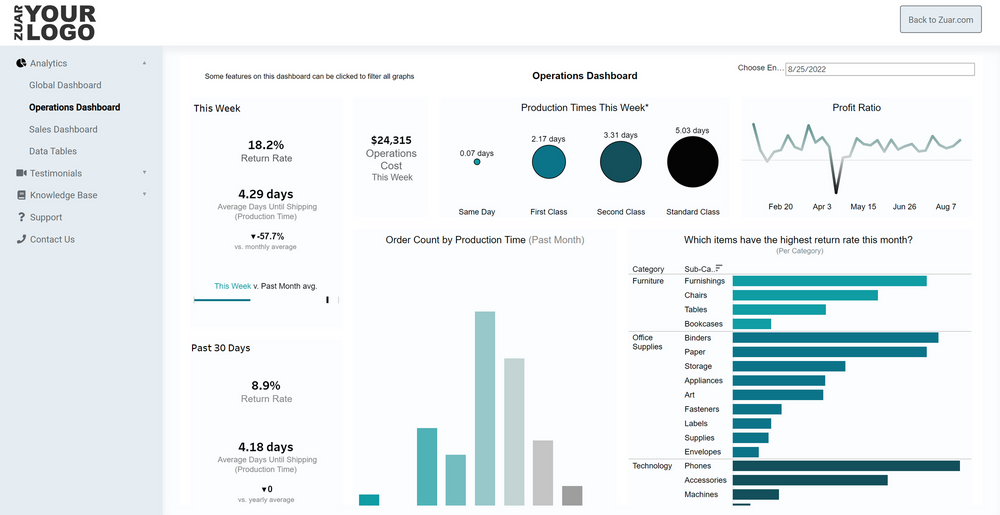
4. Embed Existing BI Tools and Legacy Reports — Transition on Your Terms
Many equipment rental businesses have already invested in some form of BI or reporting infrastructure. Power BI reports the finance team relies on. Tableau dashboards operations has used for years. Legacy reports from the ERP that no one is ready to retire. Zuar DXP does not require you to abandon any of it.
Embed and Unify on Day One
Zuar Portal can embed Tableau, Power BI, ThoughtSpot, and virtually any other BI tool directly into a unified, branded portal—on the same page if needed. Your existing dashboards remain accessible. Your users don't experience disruption. Your BI investments don't go to waste.
This isn't a workaround. It's an architectural strength. Zuar is purpose-built to consolidate multiple BI tools, legacy reports, raw data access, and Zuar's own native analytics all in one governed destination.
Or Replace Immediately
For businesses ready to move off legacy reporting entirely, Zuar DXP's native dashboard and application capabilities are production-grade replacements—not a transitional stopgap. The AI-assisted development workflow means rebuilding an existing report in Zuar often takes less time than the next quarterly maintenance cycle on the legacy system would have.
The Choice Is Yours
Embed and augment for a gradual transition. Replace right away to capture the full benefits. Or start with embedding and evolve as confidence builds. Zuar DXP supports all three paths, which is exactly why equipment rental businesses with complex, layered analytics environments choose it as the foundation for modernization—not just another tool in the stack.

5. Zuar Labs: Rapid Deployment, Real Adoption, and Continuous Improvement
Software licenses don't deliver outcomes. Teams do. Zuar Labs is Zuar's services and customer success division—and it's a major reason why equipment rental businesses choose Zuar over platforms that offer only software and minimalist support programs.
What Zuar Labs Delivers
- AI Center of Excellence — Understanding where your data and analytics practice stands today, and mapping the path to where it needs to go.
- Data discovery and modeling — Working with your actual source systems (including the legacy ERP and the homegrown dispatch tool) to build the data models that power trusted analytics.
- Portal UX and front-end design — Building the dashboard and portal experiences that users actually adopt, not just technically functional views that gather dust.
- Training, enablement, Continuous Improvement — Ensuring your team can operate, extend, and improve the platform independently over time. The relationship doesn't end at go-live. Zuar Labs partnerships are built for ongoing advancement.
Packaged Offerings
Zuar Labs offers structured packages including Data Experience as a Service, Data Orchestration as a Service, and the AI-Driven Analytics HQ Center of Excellence. For equipment rental businesses that need to move fast and can't afford a long, uncertain implementation timeline, these packages deliver predictable, outcome-focused results.
Organizations using Zuar are directly driving time savings, faster decision cycles, and revenue impact. The Zuar Labs model means you're not buying a license and hoping for the best—you're buying a result, with expert partnership built in.
6. The Zuar Equipment Rental Content Pack: From Template to Production in Days
Zuar has worked with equipment rental, fleet, logistics and field service operations businesses of all shapes and sizes, and small window into that experience is codified in a dedicated Equipment Rental Content Pack.
Content Packs are a feature of Zuar Portal 1.19—a framework for packaging complete Portal assets (dashboards, pages, application components, navigation, JavaScript, and styling) into reusable, deployable bundles. The Equipment Rental Content Pack includes production-ready templates for the core KPIs and operational views every rental business needs:
- Rental Overview — LTA/STR ratios, active rental balance, total units assigned, LTA utilization with threshold alerts, estimated monthly charges, and overdue/unaccounted unit counts.
- Equipment Tracking — Fleet status by location, equipment class, and status category (At Grower, In Transit, At Retailer, Awaiting Recovery, Returned, Unknown).
- Recovery & Credits — Monthly rental fees, recovery charges, recovery credits, and scan refunds—by month, with drill-down to transaction detail.
- Customer-Facing Views — Branded customer portals with scoped access to their own rental data.
The key takeaway is not the templates themselves—it's what they represent. Zuar has extensive, proven experience in the equipment rental industry, and the Content Pack reflects that knowledge base. But because Zuar DXP's AI-assisted development workflow is so fast, any of these starting points can be transformed into a full, customized production suite tailored to your specific operation, your ERP, your contract structures, and your business logic faster than in any other platform today.
Build once. Deploy anywhere. Customize everything.
The Decision Framework: Why Zuar DXP Is the Right BI Foundation for Equipment Rental
Choose Zuar DXP if:
- Your data lives across a rental ERP, accounting system, maintenance tools, and branch spreadsheets—and you need a reliable integration layer to unify it.
- You serve more than one audience: internal operators, external customers, and/or vendor/partner portals.
- You need dashboards that trigger action, not just display data.
- You want to leverage AI in your analytics workflow without sacrificing governance or security.
- You have existing BI investments (Tableau, Power BI, legacy reports) that you want to preserve during a transition.
- You want expert services that guarantee outcomes, not just a software license.
Consider staying with a traditional BI tool if:
- Your audience is exclusively internal analysts and your data is already clean, structured, and centralized.
- You have no customer-facing or partner-facing analytics requirements.
- Reporting is strictly read-only and no workflow integration is needed.
For most equipment rental businesses operating at any meaningful scale, the first list is the accurate one.


Frequently Asked Questions
What is the best BI platform for equipment rental businesses?
The best BI platform for equipment rental businesses is one that can handle complex ERP data integration, serve multiple audiences (internal, customer-facing, and partner portals) with granular security, and go beyond static dashboards to trigger action and workflow. Zuar DXP is the only platform that combines data pipeline orchestration (Runner), a governed multi-audience portal (Zuar Portal), AI-assisted dashboard construction, and writeback/workflow integration in a single unified framework purpose-suited to the equipment rental data environment.
How does Zuar connect to rental ERP and legacy systems?
Zuar Runner connects to APIs, relational databases, flat files, cloud storage, and custom endpoints—including legacy ERPs, homegrown systems, and telematics platforms that have no native analytics integration. Runner models and normalizes the data, builds semantic maps and materialized analytical tables, and keeps everything refreshed on schedule so dashboards remain accurate and performant.
Can Zuar serve customer-facing analytics portals for equipment rental?
Yes. Zuar Portal is specifically designed to serve both internal and external audiences from one governed platform. Customer portals inherit Row-Level Security enforced at the data connection level—customers see only their own records—with full white-label branding control and per-audience theme settings.
What is the Zuar Equipment Rental Content Pack?
The Equipment Rental Content Pack is a packaged Portal dashboard page built specifically for the equipment rental industry. It includes templates for Rental Overview, Equipment Tracking, Recovery & Credits, and customer-facing portals. Content Packs can be deployed and customized to a specific business's ERP, data model, and requirements rapidly, using Zuar Labs expertise and or the DXP's AI-assisted development workflow.
Can Zuar DXP embed existing Power BI or Tableau dashboards?
Yes. Zuar Portal can embed Tableau, Power BI, ThoughtSpot, and other BI tools directly into a unified, branded destination—on the same page if needed. This allows equipment rental businesses to preserve their existing BI investments during a transition, or maintain them permanently as part of a consolidated analytics hub.
What is Zuar Labs and how does it help equipment rental businesses?
Zuar Labs is Zuar's services and customer success division. It provides implementation, data modeling, portal design, training, enablement, and continuous improvement services. For equipment rental businesses, Zuar Labs compresses the time from contract to production, ensures high user adoption, and builds the organizational capability to extend and improve the platform over time. Zuar Labs customers buy outcomes, not just software licenses.
How does Zuar DXP handle writeback and workflow integration?
Zuar Portal's Writeback capability allows users to push data from the analytics layer back into the data layer that contains all operational systems records, updating overrides for a record, classifying an asset, triggering a sequence that approves a contract action—directly from the dashboard interface. Triggered jobs and sequences in Zuar Runner can be activated from Portal events, allowing metric thresholds to initiate automated workflows: recovery alerts, renewal sequences, escalation routing, and more.
Does Zuar support AI-assisted dashboard development?
Yes. Zuar Portal 1.19 introduced the Experience Assistant—an AI-powered application builder that generates visualizations from natural language descriptions within Portal's governed Block framework. The platform supports a full development spectrum from no-code drag-and-drop to AI-assisted vibecoding to full custom code in HTML, CSS, JavaScript, Python, and SQL—all within the same security and governance framework.
Is Zuar DXP suitable for smaller equipment rental businesses or only large enterprises?
Zuar DXP is designed to scale from mid-market to enterprise. The Equipment Rental Content Pack and Zuar Labs packaged services are specifically structured to give smaller and mid-sized rental businesses access to enterprise-grade analytics architecture without requiring large internal data engineering teams. Zuar Labs can operate as an extended analytics team for businesses without dedicated BI resources.
The Bottom Line
The equipment rental industry is not short of data. It's short of platforms that can handle the full complexity of that data—from the legacy ERP and the homegrown dispatch system, to the customer portal and the partner dashboard, to the workflow that fires when a utilization threshold is breached.
The last generation of BI leaders were built for a different world. Zuar DXP is built for yours.
If your equipment rental business is evaluating its analytics foundation—whether you're replacing a brittle reporting setup, trying to serve customers with a branded portal, or looking to finally get trusted data out of a complex ERP environment—Zuar DXP is the modern stack built to meet you where you are and take you where you need to go.